Product-performance statements in this article remain attributed to DeRUCCI unless independently verified.
Quick Take
At Furniture China 2026, DeRUCCI (慕思), a Chinese sleep-products brand, introduced an AI sleep-product lineup led by its flagship T12 smart mattress. DeRUCCI says the product combines edge AI, local processing, sensing and 14-zone dynamic adjustment; for overseas brands and retailers, the launch provides a concrete example of how traditional furniture can add digital functions, interactive retail and ongoing services.
Observed on-site by BoleChinaExpo at the Shanghai New International Expo Centre (SNIEC) on September 8, 2026.
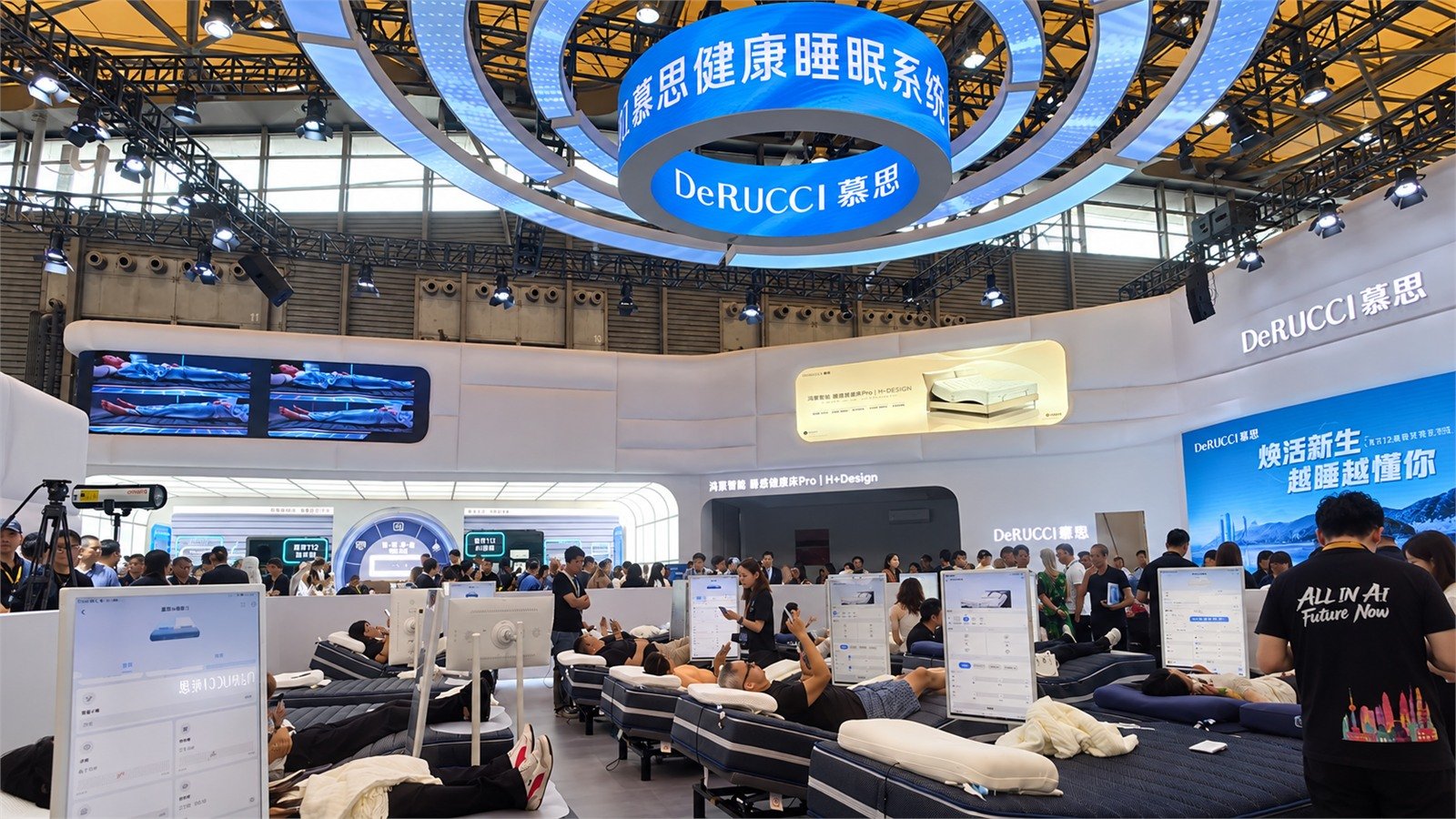
At the DeRUCCI booth, the display looked very different from a conventional mattress presentation.
Visitors were lying on beds to test the products. Nearby screens showed sleep-related data and AI functions. Further into the booth, we recorded the DeRUCCI brand and the launch theme:
“Reignite the Core. The More You Sleep, the Better It Understands You.”
DeRUCCI’s official release confirmed that the company held a product launch that morning and introduced an AI sleep-product lineup led by its flagship T12 mattress.
What You Can Find Here
How Does DeRUCCI Say the T12 Uses Edge AI in a Smart Mattress?
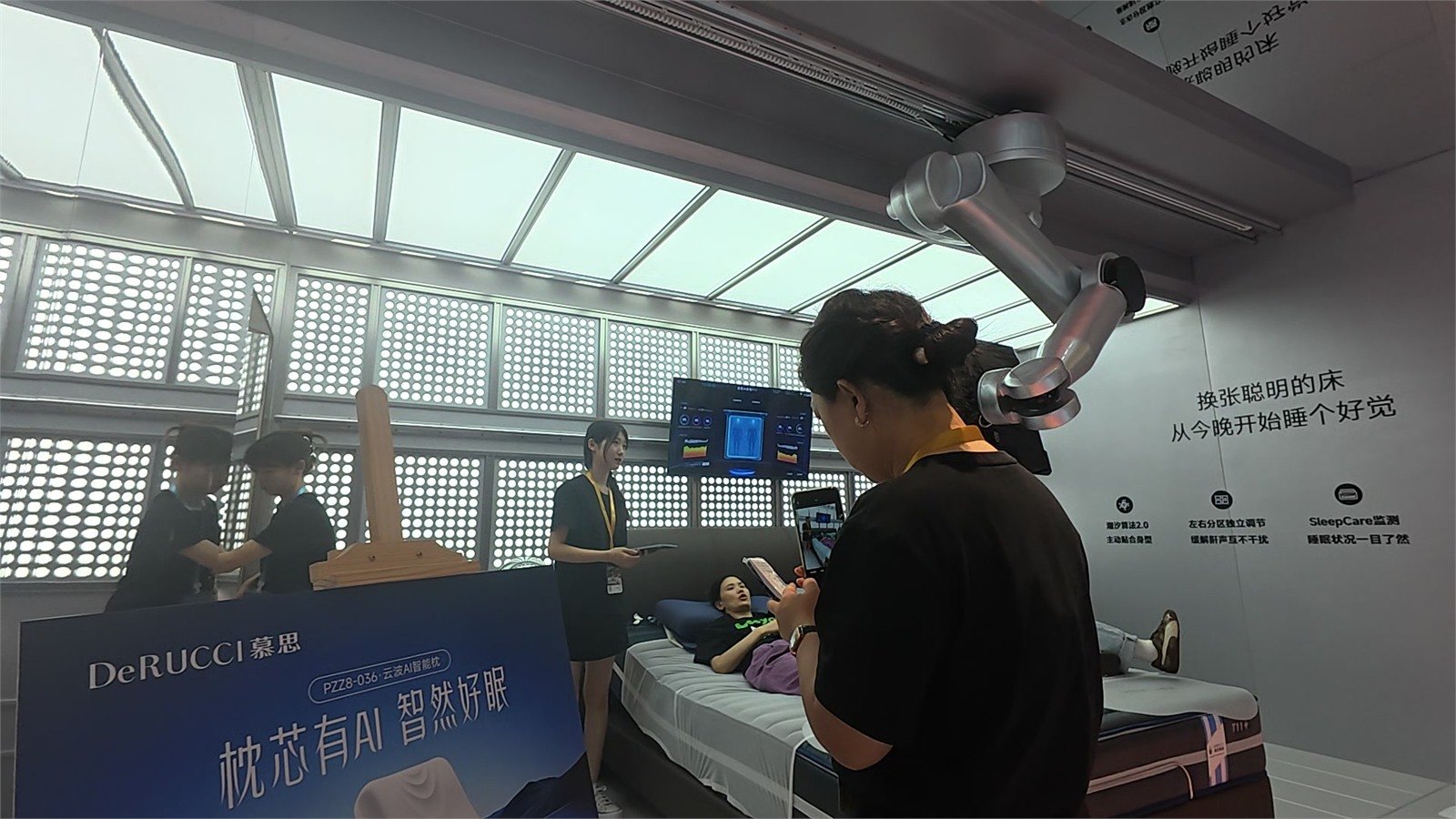
The technical claims below are based on DeRUCCI’s official launch materials.
Edge AI refers to processing more data and AI functions on the device itself rather than relying entirely on remote cloud computing.
DeRUCCI says the T12 uses an edge-AI architecture, with part of the sensing and model processing handled locally on the mattress.
The company says the system is designed to:
- sense sleep conditions;
- recognise sleeping positions;
- learn from individual sleep data over time;
- adjust support across different zones;
- run part of the AI model locally;
- continue recording during network interruptions and synchronise later.
DeRUCCI also says the T12 uses 14 independent zones across the two sides of the mattress and adjusts them dynamically through its proprietary algorithms.
If these functions perform consistently in real use, the product concept goes beyond choosing a mattress that is simply “soft” or “firm.” It moves toward a product that tries to adapt over time.
Why edge AI matters as a product direction
Many connected products depend heavily on cloud processing.
Moving more computing onto the device can create several product possibilities:
- faster local response;
- less dependence on a continuous internet connection;
- more persistent personalisation;
- a stronger foundation for ongoing digital services.
Claims such as “faster,” “safer” or “more accurate” remain DeRUCCI’s own product claims unless independently validated.
How Could AI Smart Mattresses Change Premium Retail?
For premium mattress retailers, smart functions create another way to differentiate a category that has traditionally been sold through:
- materials;
- firmness;
- comfort;
- brand reputation.
An AI-enabled product can add a new layer:
- personalised adjustment;
- visible data feedback;
- interactive demonstrations;
- digital sleep reports.
That can change how the product is presented in-store.
Instead of showing a mattress as a static object, a retailer can build the sale around an experience:
- let the customer lie down;
- show data or adjustment on a screen;
- demonstrate different modes;
- explain how the product responds.
The experience itself becomes part of the merchandising.
How Could a Smart Mattress Fit into a Connected Bedroom?
If a mattress can sense and respond, it can potentially sit inside a wider smart-bedroom environment.
That creates possible connections with:
- lighting;
- air conditioning;
- curtains;
- bedroom automation;
- other connected devices.
DeRUCCI has previously explored links between sleep products and smart-home ecosystems.
For companies already working in smart home, the opportunity is not necessarily to sell “a smart mattress” as an isolated product. It may be to consider whether sleep becomes another part of a connected bedroom system.
Could Smart Sleep Become Part of the Hotel Guest Experience?
At the launch, speakers also discussed the possibility of sleep-related experiences extending beyond the home into settings such as travel and hotels.
For hotels, serviced apartments and premium accommodation, that creates possible questions:
- Could personalised sleep become a room differentiator?
- Could smart beds form part of a premium-room package?
- Could sleep-related data or adjustment create a new guest experience?
These are potential use cases rather than evidence that the T12 is already deployed at scale in those settings.
For hospitality operators, the concept may be worth testing in:
- premium rooms;
- wellness-focused properties;
- long-stay accommodation;
- demonstration suites.
How Could Smart Sleep Products Extend from Hardware into Wellness Services?
If a sleep product can continuously sense and record data, the commercial model can extend beyond a one-time hardware sale.
Possible directions include:
- sleep-management services;
- wellness content;
- membership programmes;
- in-store or in-hotel sleep experiences;
- data-supported customer engagement.
This is where the wider significance of the T12 becomes clearer.
The show itself remains primarily about furniture, upholstery, design, materials and supply chains. But the T12 provides a concrete example of how a traditional home product can begin to add:
sensing → algorithms → data → continuous adjustment → service
That logic may eventually extend beyond mattresses into:
- seating and sofas;
- office furniture;
- wellness furniture;
- hospitality furniture;
- smart bedrooms;
- other products where human sensing and personalised adjustment create value.
The question for an overseas brand, distributor or product-development team is not whether every piece of furniture needs AI.
A useful question is:
Could sensing, adjustment or digital services add a new layer of value to a product category you already sell?
The T12 is one visible example of that direction becoming real on a furniture-show floor.
Source Notes
The local evidence confirms the DeRUCCI booth, AI sleep-experience area and the launch context. Product specifications and performance claims remain attributed to DeRUCCI.